
A clean account setup is not decoration. It determines how quickly you can find problems, how safely you can test new ideas, and how much money you waste while learning. In a Google Ads account, structure is the skeleton under everything else.
The trouble is that a lot of accounts start with one campaign, a few ad groups, and a pile of keywords that only made sense on launch day. That setup can limp along for a while, but once spend grows past a few hundred dollars a day, the cracks show fast. Search terms get messy, reporting turns slow, and small changes become hard to trust.
Start with the business model, not the interface
The first mistake is building around the tabs in Google Ads instead of the way the business earns revenue. A lead gen account with five services should not be structured like an e-commerce catalog with 300 products. The account should mirror the decisions that matter: what is being sold, who wants it, and how different the margins or conversion values are.
That sounds basic, but it changes the whole shape of the account. If one service closes at a 25% rate and another at 5%, they should not sit in the same campaign just because they are related. Same goes for brands and non-brands, search and remarketing, top-funnel and bottom-funnel traffic. One campaign should usually have one clear job.
When I rebuilt a small service account last year, the original setup had 14 campaigns for three core offers. Half of them were split by geography with no real budget difference, which made reporting noisy and decisions slow. After consolidating into 6 campaigns tied to intent and value, the account became much easier to manage within two weeks.
Use campaigns to separate meaning, not to show off volume
Campaigns are where you control budget, bidding strategy, targeting, and broad intent. That means each one should justify its existence. If two campaigns share the same goal, audience, and bid logic, they probably belong together unless there is a strong reason to keep them apart.
Budget separation is the most practical reason to split. If brand search needs $40 a day and non-brand needs $400, those cannot live together without constant interference. The same is true for match type strategies, device-heavy performance, or locations that convert very differently. Campaigns are for clean control, not for making the account look busy.
There is a common belief that more campaigns equal more precision. I do not agree with that. In a lot of accounts, the opposite is true. Too many campaigns create budget fragmentation, and a campaign with 12 clicks a day will not give you enough data to make sane decisions. Precision without volume is just a prettier form of guesswork.
Build ad groups around intent clusters
The ad group structure should be tight enough to keep ads relevant, but not so tight that every keyword ends up isolated for no reason. The old habit of breaking everything into tiny themes worked better when keyword matching was narrower and search behavior was more predictable. Search is messier now, and the structure has to respect that.
A useful ad group usually contains a set of closely related queries that share the same landing page and ad message. For example, a plumbing account might separate emergency repair, water heater replacement, and drain cleaning into different ad groups because the customer’s intent and the offer are different. Each one can then point to copy that feels specific instead of generic.
In practice, the sweet spot is often 5 to 20 keywords per ad group, though some accounts need more and some need fewer. What matters is whether the search terms produce one clear theme. If you need three landing pages or three distinct headlines to make the group feel coherent, it is probably too broad.
I once inherited a campaign where 60-plus keywords lived in a single ad group for “commercial cleaning.” It was an absolute mess: office cleaning, warehouse cleaning, floor stripping, and post-construction cleanup were all fighting for the same ads. Splitting that into 4 ad groups immediately clarified the reporting and reduced irrelevant clicks within the first month.
Choose a campaign naming convention early
Names are not cosmetic. A good campaign naming convention lets you understand the account in seconds, even when you have not touched it for a few weeks. A bad one forces you to open every campaign just to figure out what it does.
Keep the format simple and consistent. Many teams use a pattern such as network, geography, intent, and objective, like Search_US_Brand_LeadGen or PMax_National_HighValue. The exact order matters less than sticking to it. If you mix location in one place, match type in another, and device in a third, nobody will trust the labels.
A naming system also helps when multiple people work inside the same account. Even a team of two can waste 30 minutes per week sorting through sloppy names. That does not sound dramatic until it happens every week for a year.
Decide how much control you really need
Not every account needs the most granular setup possible. The best structure is the one that supports decisions without creating busywork. Sometimes that means fewer ad groups and broader themes, especially when the account has limited traffic or a short conversion window.
The obsession with micromanaging every keyword is one place where conventional advice has aged badly. A skag alternative can make sense when the account has enough volume to justify it, but single-keyword ad groups are no longer the default answer for most search accounts. Smart structure now depends more on grouping by query intent, landing page fit, and conversion value than on forcing one keyword into one box.
That said, there are exceptions. Very high-budget accounts in regulated industries, or accounts with dramatic differences in intent and legal language, may still benefit from narrower isolation. Structure should serve the risk profile and the data volume, not a trend from five years ago.
Separate by match type only when it earns its keep
Match type can be useful, but splitting campaigns just to isolate every keyword type is usually too much once an account matures. Broad, phrase, and exact can live together when you have strong negatives, clean reporting, and clear bid logic. The account should not become a museum of match types.
There are still cases where match-type separation makes sense. If exact match is tied to high-margin branded queries and broad match is used for discovery, keep them apart so budget and bidding do not collide. But if you are running a smaller account with 2 or 3 conversions a week, over-separating by match type can starve everything.
One practical way to test this is to watch data volume over 30 to 60 days. If a split campaign cannot generate enough clicks or conversions to inform a decision, the structure is too fine. A neat dashboard does not help if every line is too thin to mean anything.
Use the landing page as a structural anchor
People often treat landing pages as an afterthought, but they should shape the account from the start. If two ad groups point to the same page, they probably share enough intent to sit near each other. If one page is for pricing-sensitive traffic and another is for enterprise buyers, they should not be trapped in the same structure.
This matters even more when your site has separate service pages, category pages, or lead forms for different offers. A campaign that sends traffic to one page per intent tends to be easier to read and improve. When traffic is spread across unrelated pages, the account starts to feel like a bucket of unrelated experiments.
A helpful rule is to ask whether the landing page would still make sense if you removed the ad copy entirely. If the page can stand on its own for that search intent, the structure is probably aligned. If not, the mismatch usually shows up later in weaker conversion rates or higher cost per lead.
| Structural layer | Primary job | Common mistake | Better test |
|---|---|---|---|
| Campaign | Budget and bid control | Splitting for no clear reason | Can these share the same budget and goal? |
| Ad group | Message and intent alignment | Too many unrelated keywords | Would one ad and one page fit the group? |
| Keyword set | Query coverage | Isolated keywords without data | Does the group get enough traffic to learn? |
Keep reporting useful from the start

A strong account structure does more than organize ads. It makes reporting faster to interpret. If brand, non-brand, and remarketing are separated cleanly, you can see where budget goes and what kind of traffic produces results without digging through a hundred rows.
This is one reason to avoid building an account around internal company labels that mean nothing to the people working in it. A campaign named “Q4 Growth North” might make sense in a meeting, but it tells you almost nothing about intent or offer. Better names save time in every report, every audit, and every handoff.
Set up conversions and values with the structure in mind, too. If lead quality varies by campaign, a flat cost-per-lead view can hide the real story. Even a difference of 20% in conversion value can justify a very different bidding decision, so the structure should let those differences surface cleanly.
Where first-person troubleshooting saves time
In a build I worked on about 18 months ago, the account looked fine at a glance but kept underperforming on mobile. The issue was not the bids; it was that mobile-heavy terms were buried inside broad ad groups with mixed landing pages. Once we separated the highest-intent mobile queries into their own smaller groups, the team could actually see the pattern instead of guessing at it.
That kind of fix is only possible when the structure is readable. If everything is blended together, you can still optimize, but you will do it by feel and by cleanup, not by signal. A tidy account does not guarantee success, yet a tangled one almost guarantees extra work.
Review the structure before adding more keywords
One of the most useful habits is to pause before expanding the account. If performance is slipping, the answer is not always another keyword set or another campaign. Sometimes the structure is already doing too much, and adding more only makes the mess larger.
A quick audit can catch a lot. Look for campaigns that share the same audience and goal, ad groups that chase multiple intents, and names that no one can decode without a legend. If a new person joining the account would need a 30-minute walkthrough just to find the brand campaign, the setup is too opaque.
- Check whether each campaign has one main objective.
- Make sure each ad group shares the same search intent.
- Confirm that the landing page matches the query theme.
- Remove splits that do not change budget, bidding, or reporting.
- Rename anything that would confuse a new team member.
That list is short on purpose. Structure work gets bloated when it turns into theory instead of cleanup. A few practical checks each month will do more than a massive rebuild every year.
Let the structure evolve with volume
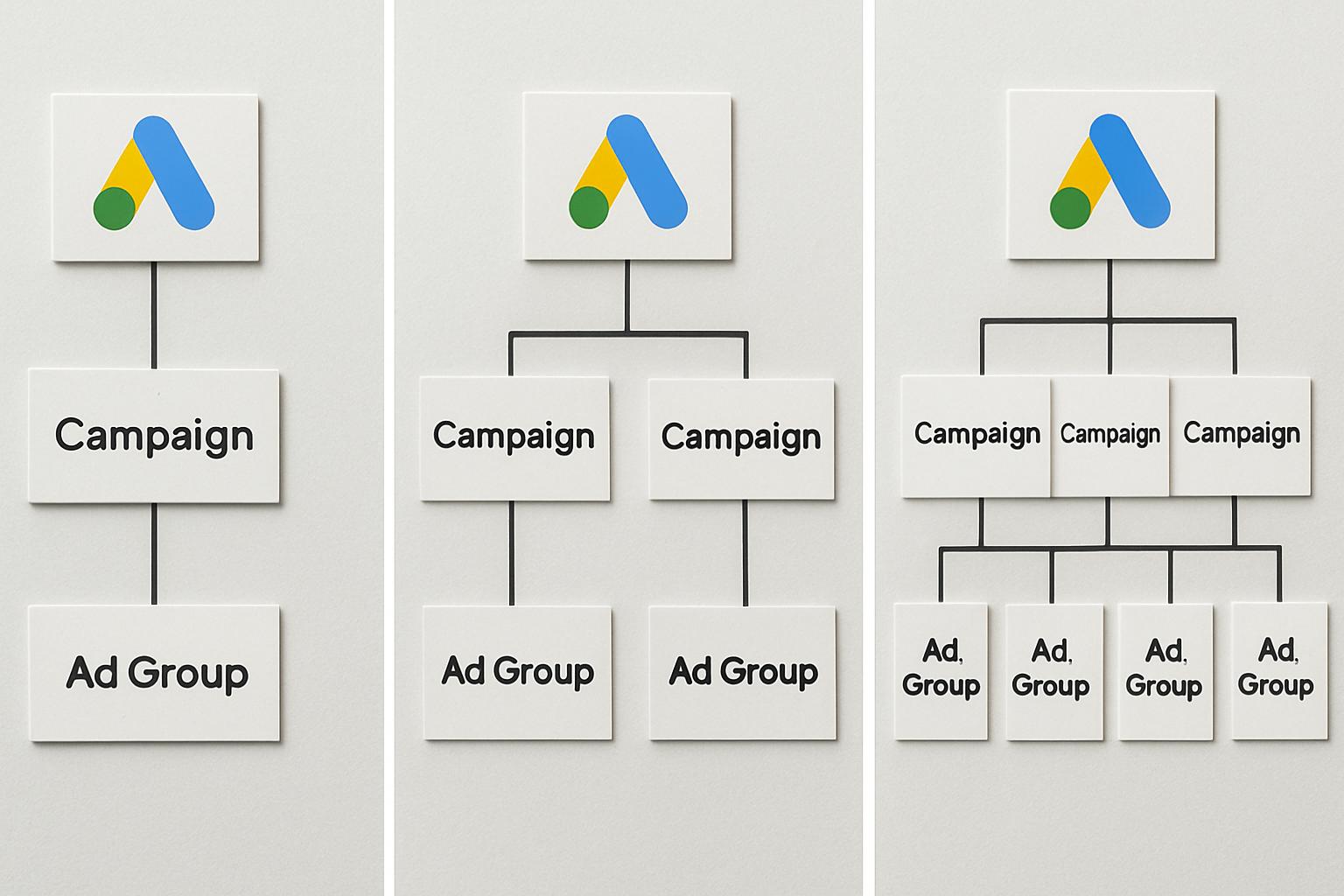
Good accounts do not stay frozen. A setup that worked at 500 clicks a month may fall apart at 5,000. Once you have enough volume, a broader campaign can be split by geography, device behavior, or conversion value. Before that point, the split is usually premature.
The same is true in reverse. When a niche campaign only gets a handful of conversions per month, tightening it further may hurt more than it helps. Smaller accounts need patience and simplicity. Bigger accounts need sharper boundaries.
The real measure of a google ads account structure is not how sophisticated it looks on paper. It is whether you can answer practical questions quickly: where is money going, which intent is converting, and what needs to change next. If the account helps you answer those questions without a scavenger hunt, it is doing its job.